
Key insights from Pálma Szolnoki's presentation at the CATL event
At the recent CATL event, Pálma Szolnoki of the Hungarian Battery Association presented a comprehensive overview of the Hungarian energy storage market. The association was founded five years ago and now has more than 100 members. Pálma leads its Battery Energy Storage working group, which monitors closely the development of the Hungarian BESS market and prepares recommendations to the government on subsidy design and regulation. The main points are summarised below.
Businesses: subsidy only for energy-intensive consumers. The utility-scale round is closed and no new round has been announced. Standalone storage and new grid-scale PV receive no subsidy and no new grid connections.
A detailed breakdown follows in section 4.
1. A structural mismatch between solar output and demand
Hungary has nearly 9 GW of installed solar. Peak demand is only about 7.5 GW in summer and 8.2 GW in winter. Installed wind capacity, which could balance solar output, is only 330 MW.
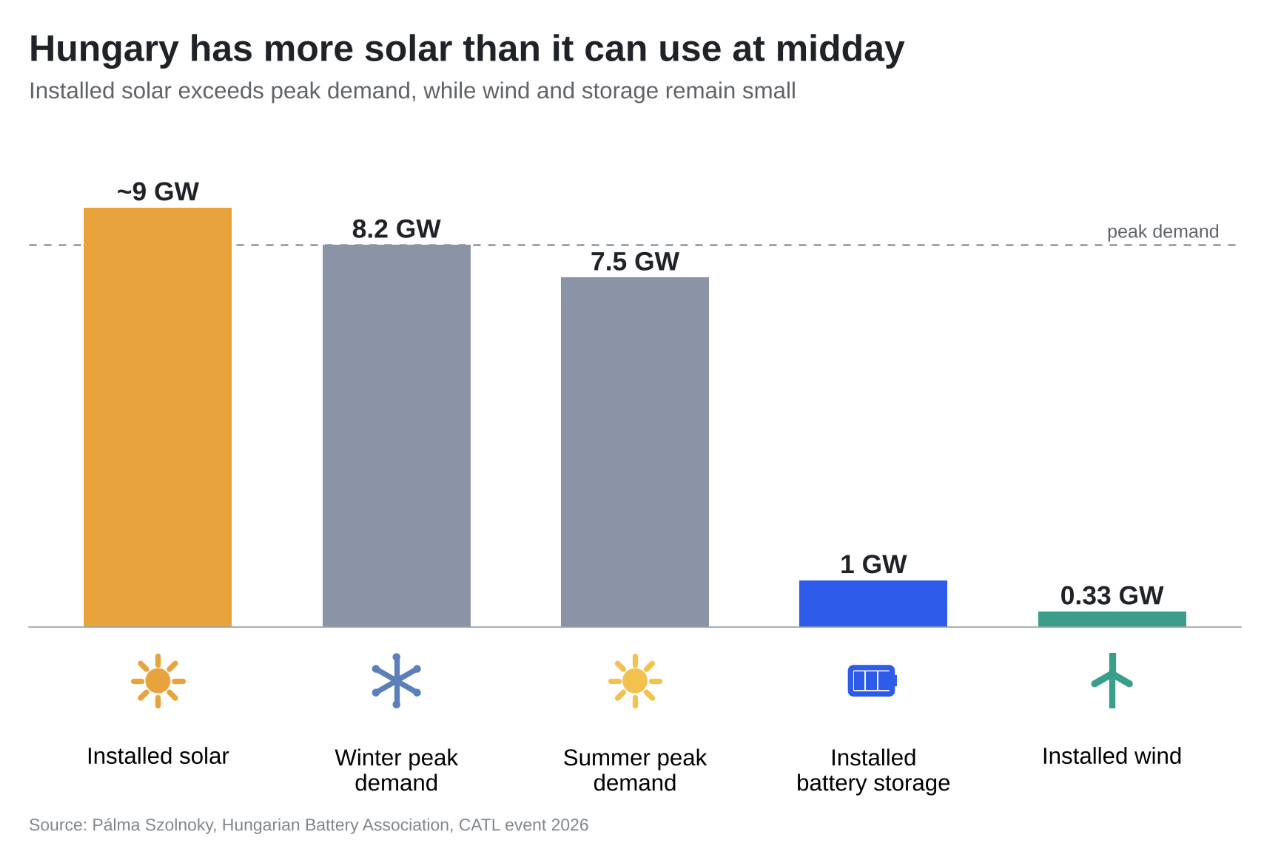
The revised National Energy and Climate Plan targets 12 GW of PV, 1 GW of wind and 1 GW of storage by 2030. The new government has raised the wind ambition well beyond that plan: it targets at least 4,000 MW of new wind capacity by 2030, more than ten times today's fleet, allocated through annual grid-capacity auctions. The first auction, announced on 30 August 2026, offers 702 MVA at nine grid nodes, with bids due by 30 October and connections from 2030. These projects are still years away from operation. Until then, flexibility has to come from storage.
2. Pronounced price volatility
- Daily spreads: the gap between the highest and lowest day-ahead prices has topped €800/MWh on some days. Annual averages have held around €150/MWh in recent years, among the highest in the region alongside Romania.
- Negative prices: 280 negative-price hours so far this year.
- Solar cannibalisation: since 2024, PV capture rates have hovered around 60% from spring to autumn. In April, with solar at full output and no heating or cooling demand, they fell below 40% this year.
3. Grid connection constraints
- Medium and high voltage: no new connections are being granted to PV or storage. Standalone storage will not get new injection connections, so growth will not come from standalone projects.
- Low voltage: about 7% of areas are already closed.
4. Public funding: private individuals and businesses
Current subsidies favour households and energy-intensive consumers. Other businesses can still invest in storage, but without public funding and only where a grid connection already exists.
Businesses
- Subsidy, energy-intensive consumers: a dedicated storage scheme has already launched.
- Closed round, utility-scale storage: the previous scheme offered up to 45% CapEx support plus a CfD-style OpEx mechanism. It delivered 550 MW and about 1 GWh, due online by Q2–Q3 2026. No new round has been announced.
- Options without subsidy: adding storage to existing PV plants (hybridisation), co-location behind an existing connection (rules expected to improve by January), priority grid access for wind projects with storage, and flexible connection agreements under development.
- Not available: standalone storage and new PV at medium or high voltage receive neither subsidy nor new grid connections.
5. Current market status
The 1 GW storage target for 2030 has already been reached.
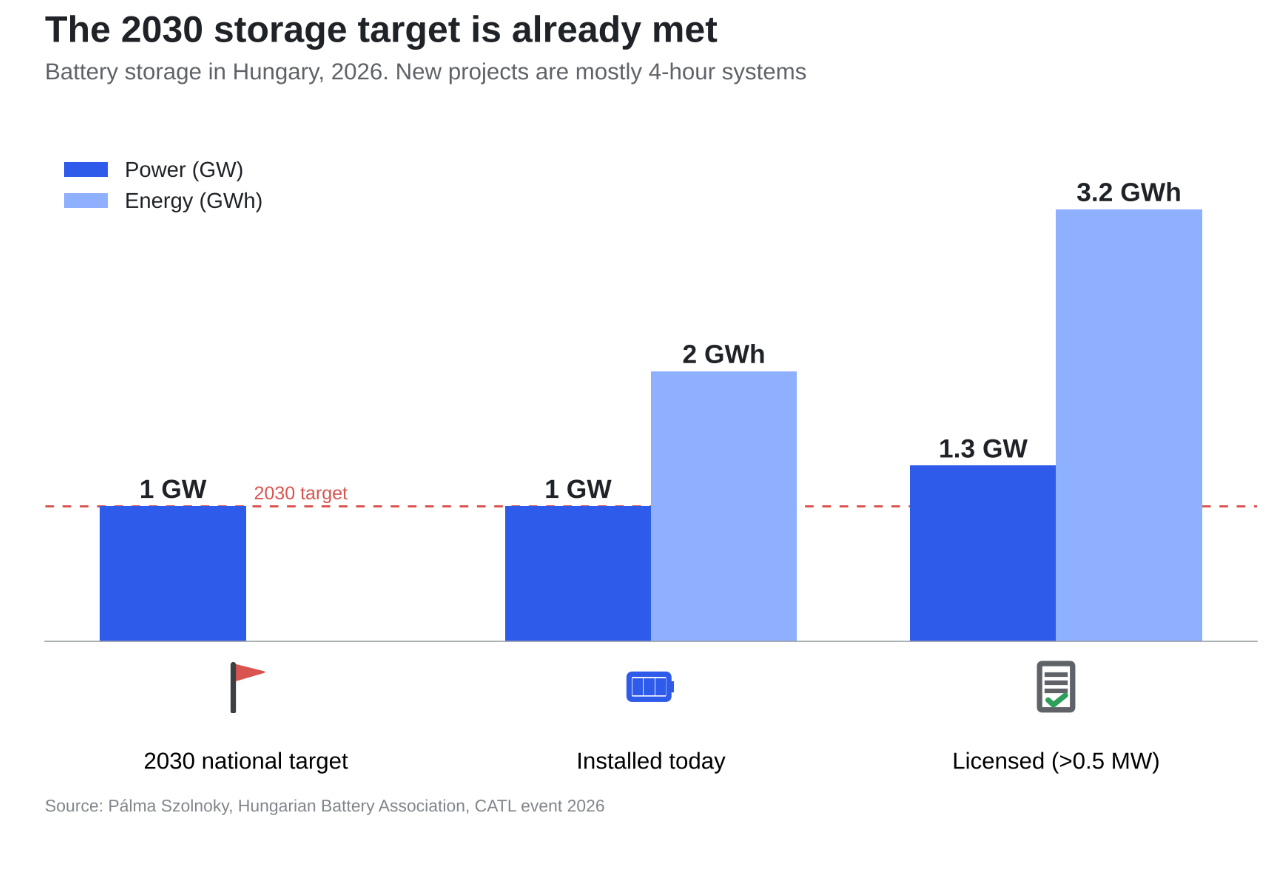
- Installed: about 1 GW / 2 GWh is now operating. Most of it came online in the first half of 2026 as subsidised projects met their deadlines.
- Licensed (projects above 0.5 MW): about 1.3 GW / 3.2 GWh.
- Durations are getting longer: the first projects in 2018 were one-hour systems built for FCR. By 2024–2025 the market had moved to two hours, and most new projects are now four-hour systems built for energy arbitrage.
6. Drivers of future growth
- Low-voltage advantage: new generation on the LV grid is capped at 50 kVA, but storage is exempt.
- Wind plus storage: in the first wind auction, bids that add battery storage (up to the size of the wind capacity) earn extra evaluation points.
- Flexible connections: following the EU electricity market reform, the TSO and DSOs are developing flexible connection agreements. The association is part of these talks, and storage is the best fit.
- PV hybridisation: unsubsidised solar owners are adding batteries to defend their revenues.
- Co-location: under Hungarian rules, a different company installs storage behind an existing connection.
Conclusion
Hungary has gone from a niche FCR market to a gigawatt-scale arbitrage market in about two years. The constraint is no longer demand for storage but grid access and smart operation. The Hungarian Battery Association is publishing a market intelligence report for investors in November, which should be valuable reading for anyone active in this market.
Thank you to Pálma Szolnoki for an insightful, data-driven presentation, and to CATL for hosting the event.
EnergyHeadhunter.DE is the energy division of Executive Headhunter Kft., specialising in executive and leadership search across the European energy supply chain.